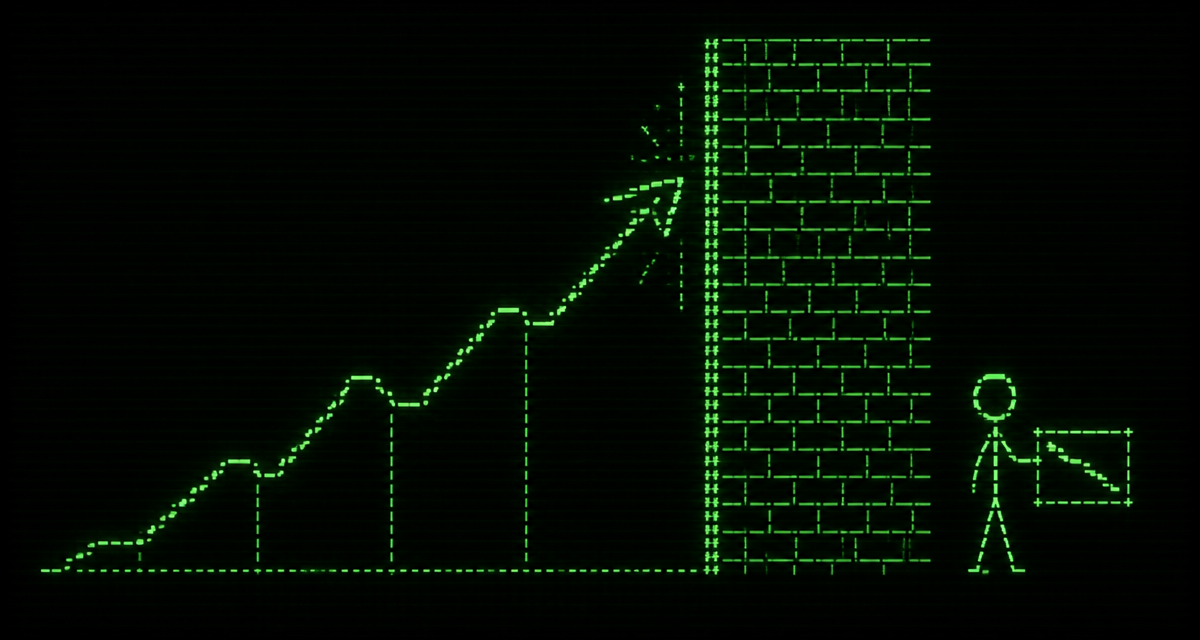
In his bestselling book The Thinking Machine, Stephen Witt tells the story of Jensen Huang and Nvidia's rise to the centre of the AI economy. One short scene in it is worth reading twice if you sit in a boardroom.
Witt recounts that in 2001, an Intel intern named Bryan Catanzaro was asked to work out whether the company could build a microchip that pulsed at ten billion beats per second. He did the math. The answer was no. The heat would be impossible to shed. Sequential processing was, in his phrase, running into a wall.
He walked the finding into a room of senior engineers. His supervisor's response wasn't to check the math. As Witt tells it, he told Catanzaro he must have done his work wrong, because the target was on Intel's roadmap. Catanzaro double checked. His numbers were fine. He left Intel, went to Berkeley for a PhD, and eventually decided the killer application for parallel computing had to be one whose hunger for compute could never be satisfied. He landed on AI. He now runs applied deep learning research at Nvidia.
Intel never got to ten. The physics the intern described is the physics that ended the era.
Where The Math Loses To The Story
Nvidia has become the default supplier of the compute layer for the AI economy. Intel's own strategy took it somewhere else. That divergence didn't happen in a single quarter. It opened over years of decisions where a published roadmap kept beating arguments the math should have won.
Strategy research has documented this pattern for decades. Daniel Kahneman, Dan Lovallo and Olivier Sibony's HBR piece on big decisions describes what happens once a team falls in love with its own recommendation. Awkward evidence gets brushed aside. One friendly number gets treated as proof. Comparisons get made to cases that don't apply. It happens most reliably when a strategy has already been sold up the chain and the calendar has been built around it. Attacking the messenger is cheaper than rewriting the plan.
McKinsey calls the same thing by a different name. In its guide to digital disruption, the firm describes how incumbents with strong positions take false comfort while the weaker players in their industry get hit first, tell themselves "it is not happening to us," and watch the financials instead of the underlying drivers that moved years earlier. What Catanzaro presented was one of those underlying drivers. What he got back was the false comfort of a printed roadmap.
Why Junior Signals Almost Never Land
According to what I read in Witt's book, the failure mode here wasn't refusing to listen. Intel didn't refuse to listen. A senior engineer heard Catanzaro out. What Intel refused to do was update. The finding was accepted as valid physics and then dismissed as inconvenient for the strategy. That's the harder problem.
I see the same pattern in transformation work more often than I'd like. A junior analyst runs the numbers and concludes the growth assumptions don't hold. A frontline manager says the CRM the board approved won't behave the way procurement thinks it will. A data scientist says an AI pilot's results look good only because of how the sample was drawn. Each finding gets a hearing. None of them changes the plan.
Part of that is money. Rewriting the plan costs more than defending it. Part is politics: whoever signed the plan doesn't want to unsign it. And part is identity. Leadership has to accept that the baseline they've built their careers on is now in decline, and that's a psychological bridge most people won't cross voluntarily.
The biggest part, though, is structural. Most executive teams have no formal route for a signal that comes from below. The rituals of the corporate calendar, the quarterly review, the roadmap update, the strategy offsite, all assume information moves from the top down. When it moves the other way, from an intern, an analyst, or a shift lead, there's nowhere for it to land.
What Changes The Outcome
Three shifts help. The first is separating "is this true" from "is this convenient." In the book, it seems that Catanzaro's supervisor collapsed the two. Once evidence is scored on convenience, no amount of technical rigour saves it. Boards that treat those as different questions, and resolve the technical one first, tend to catch the contrary signal earlier.
The second is building an actual route for findings that move upward. Most companies I work with have a whistleblowing channel for misconduct and nothing equivalent for strategy dissent. A quarterly "if the plan is wrong, tell us why" session, minuted and reported to the board, is more useful than any offsite.
The third, and hardest, is being willing to be embarrassed in public by a junior colleague who saw it first. That's a cultural choice, not a process one. It's also what separates the companies that end up on the winning side of a technology divide from the ones that end up trailing.
Andy Grove, who ran Intel through its most successful decade, wrote a book in 1996 called Only The Paranoid Survive. His central instruction to executives was to hunt for the Cassandras inside the organisation, the people close to the market who feel the shape of disruption before the executive floor does, and to listen to them carefully. Turns out Intel had its own former CEO's playbook. It had a Cassandra sitting in an internship. Yet by Witt's account, it told him he'd done his math wrong.
The analysis above is my own assessment, based entirely on the published account in Stephen Witt's The Thinking Machine. It does not draw on any non public information from Intel, and it is not affiliated with, endorsed by, or representative of Intel or its views.